“This program delivers professional-grade knowledge.”
“Dedicated and extremely knowledgeable.”
“Lucas is always available to answer your questions.”
Run your own quant desk. Alone.
The AI Quant Pod is a video course, plus a team of seven AI agents ready to run in Claude Code. They read the papers, attack your ideas, backtest, kill what is luck and build your book. You make the final call.
The price only goes up
Presale · until Nov 9$397Lab free · you are here
Black Friday · Nov 27$497Lab still free
After Black Friday$797No more Lab
9 sections + Lab bonus
Full repo: 7 agents
Runs on $20/mo Claude
1-on-1 with Lucas
The hard truth
Alone, you can’t keep up anymore
A fund puts a team of researchers on every idea. You have evenings and weekends. Before AI, that gap was only time. Now it is worse: anyone can generate a hundred beautiful backtests a night, and almost all of them are luck. There are three ways to do research alone. Only one still works.
✓ Method✗ Team
Rigorous, but slow
You do everything right, by hand: read, code, test, document. Weeks per idea. By the time one strategy is validated, the opportunity has moved.
Too slow
✗ Method✓ AI
Fast, but blind
The AI tries until something looks good and calls it promising. You get speed, and you trade luck. Further down, you will see what that does.
A lottery
✓ Method✓ AI team
Rigorous and fast
A team of agents that applies the method on every idea: sources checked, every try logged, every Sharpe judged against luck. 5 to 15 ideas every 5 hours.
A desk
The method alone is too slow. AI alone is a lottery. The AI Quant Pod gives you both: the method, applied by a team of AI agents.
What you get, in one minute
One course, one bonus, and me
If you only read one section, read this one.
The new course
AI Quant Pod
The teamSeven AI agents that do the research work of a quant desk, ready to run in Claude Code. Plus 9 video sections that show you how each one works, so you can trust it, check it and change it.
Bonus · free until Black Friday
The Systematic Trading Lab
The methodMy research course ($497 alone): how a desk finds, tests and kills strategies. The foundations every agent in the pod applies.
Support
Me, 1-on-1
The helpMentoring and a private Discord. When you are stuck, you ask me, not a forum. Capped at 50 members.
The Lab gives you the method. The pod gives you the team that applies it, about ten times faster than you can alone. One without the other is not enough. That is the whole idea of this offer.
Sound familiar?
If you have ever backtested with AI, you have probably done at least one of these
Nobody tells you, because the output looks perfect. Count how many apply to you.
01
You asked an AI for a strategy. Ten minutes later: a Sharpe of 2.3.
What actually happened
It tried until something looked good, then showed you only that. You never saw the 200 tries behind it.
02
You asked if your idea was any good. It said “promising”.
What actually happened
It says that about almost every idea. It was trained to be helpful, not to tell you that you are wrong.
03
The backtest was beautiful. Live, it slowly bled.
What actually happened
Look-ahead, missing costs or plain luck. All three are invisible in the curve, and all three are checkable before money.
04
You tested 40 variations and kept the best one.
What actually happened
That is data snooping. The best of 40 is very often just the luckiest of 40.
Two or more? It is not your fault. You are doing a desk’s job alone, with an assistant built to agree with you. Desks solved this decades ago, with people whose only job is to say no. The rest of this page shows you exactly how they do it, and how the pod does it for you.
Proof · what “AI, no method” does
Your AI is not finding edges. It is finding luck.
We let a search run on fake markets where no strategy can make money. Watch the backtest get better with every try, while the real result stays at zero. If you have ever kept “the best of 50”, this chart is your backtest.
Tries0
Best backtest Sharpe0.00
Same strategy, the year after0.00
Figure Simulation. 500 strategies with no edge by construction (random daily returns), two years of backtest, then one year after. After each try, the best backtest so far is kept. Average of 2,000 simulations.
The name of the bias
Data snooping. Each loop looks harmless. Hundreds of them, uncounted, guarantee you find something that isn’t there. An AI runs hundreds of loops a night and forgets every one. A desk logs every try, and judges the Sharpe against how many tries it took. The pod does exactly that, on every idea, automatically.
Meet your desk
Six ideas go in. Five die. That is the point.
Most ideas are bad. Yours, mine, a hedge fund’s. The difference is when you find out. The pod kills them early, cheaply and in writing, before they cost you a month or a cent. You only step in once, at the very end, to decide.
Illustration of a runIdeas 6 · Killed 0 · In the book 0
AnalystsRead
CriticCritic
Data checkData
BacktestTest
Risk teamRisk
Your callYou
BookBook
#01 Weekend effect
#02 Overnight reversal
#03 Thin losers
#04 Volume breakout
#05 Basis momentum
#06 Liquidity premium
in progresskilled, reason loggedjoins the bookyour decision
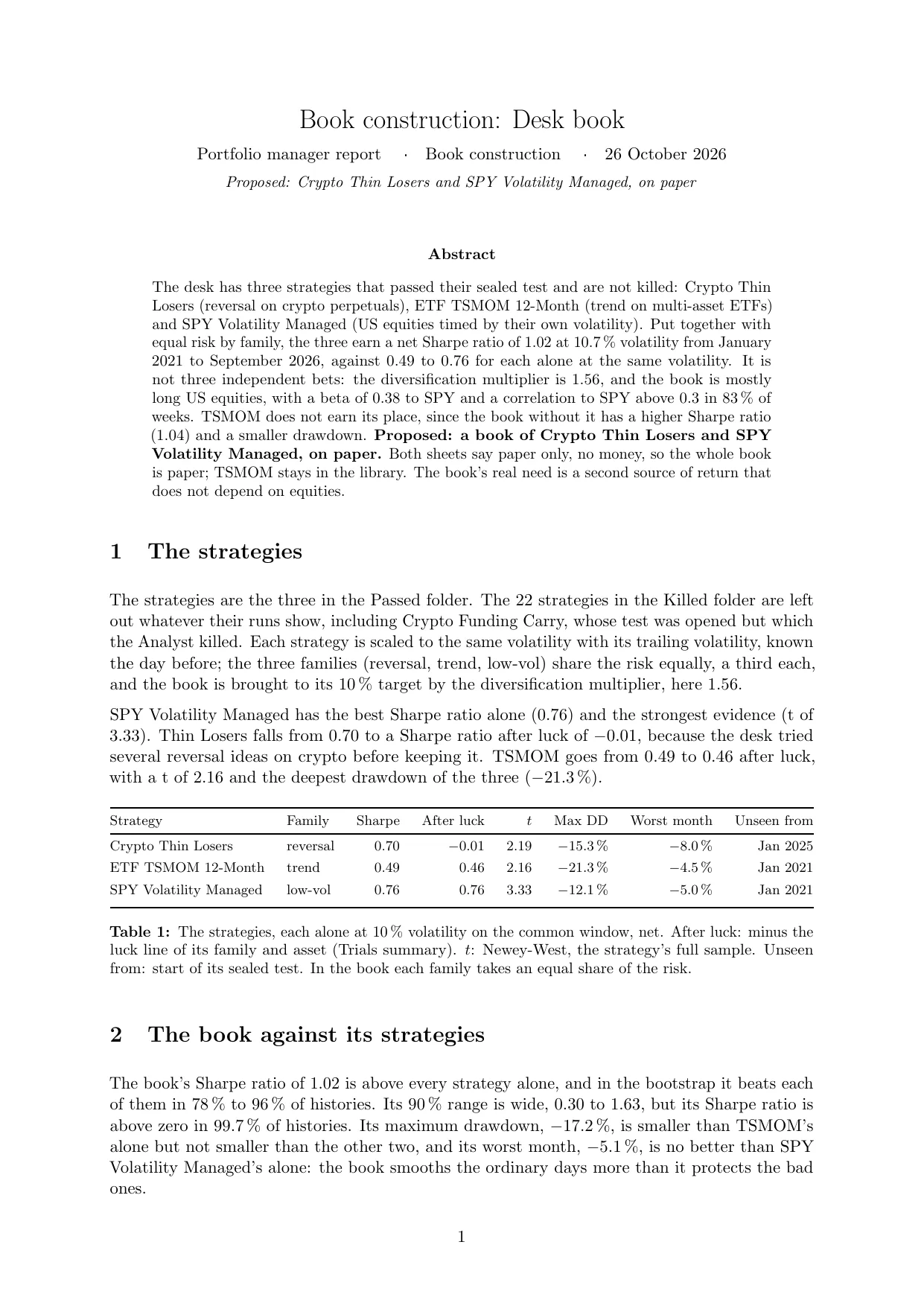
Not a mockup · real output of the pod
30 ideas in. One book out. Here is the report.
Last week, the desk judged 30 ideas, killed 27 and kept 3. Then the portfolio manager agent wrote this report on the book. Nobody edited it: this is the PDF exactly as the pod produced it. Eight pages, every number from the backtests. Flip through it.
1 command→
7 agents at work→
30 ideas judged→
1 PDF, untouched
Why I built it
I had the method. I didn’t have the team.

A desk is a team. For years, I was doing every seat on my own.
Literature review, hypothesis, data, backtest, validation, documentation: each strategy took weeks. Collaborators helped, but every one of them had to be trained on the method, and few stayed long enough for it to pay off.
So I formalised the method once, as roles with written mandates and hard rules: analysts, critic, data engineer, quant developer, risk team, portfolio manager. The first versions fabricated figures and approved weak ideas. Every failure became a rule. What remains is the pod: the research process of a small desk, run by agents, to the same standard. I now research strategies about ten times faster, with the same rigor, and I use it for my own book.
The AI Quant Pod hands you the whole process. · Lucas Inglese, quantitative researcher
$1.5Mof client capital traded live, as research lead at a systematic crypto futures firm
SSRNauthor of a paper measuring how often backtest validation lets a false strategy through
26,000+followers on LinkedIn, and hundreds of students
After the course
What you will be able to do
Run a full research cycle with one command, from papers to a finished book.
Kill bad ideas in hours, before they cost you weeks or money.
Tell in five minutes when an agent is wrong, with the checks taught for every seat.
Judge every Sharpe against luck, with every try logged and counted.
Build a book of decorrelated strategies, not one lucky backtest.
Change any agent, skill or rule for your own markets and ideas.
Curriculum
What’s inside the AI Quant Pod
Nine sections. On day one you watch the whole pod run, papers in, book out. Then you rebuild it one seat at a time, until you can open any file and know why it is there. You leave with the whole repo, running on your machine.
9AI agents, one per seat of the desk
15skills: the procedures they follow
165research notes already written
9video sections, from install to case studies
Release
Sections 0 to 2 online November 5. Sections 3 to 8 online November 12.
Section 0 · Meet your pod
Before any theory, you watch the whole desk work: papers in, book out. Then you install it, step by step. By the end of this section, the pod runs on your machine.
- A complete run, from papers to the book
- Installing Claude Code and the repo
Section 1 · How to hire an agent
The design rules most people get wrong. When a job deserves an agent, when a skill is enough, when a plain script is better, and how to keep the whole desk running on a $20 plan.
- Agent, skill or script
- Writing the hard rules
- Keeping the pod on a $20 plan
Section 2 · Your research analysts
Your analysts stop inventing numbers. They find the right papers, cite every figure to its page, and fill the library the rest of the desk draws from.
- Searching the literature
- Reading notes with sources
- The technique library
Section 3 · Your quant researchers
An idea with a real economic reason, or no idea at all. Then the critic attacks each one before a single line of code, so you stop spending backtests on hope.
- Who pays, and why
- The critic
Section 4 · Your data engineer and quant developer
Free, clean data, and a backtest you can trust on the two things AI gets wrong most often: costs and timing. No look-ahead, by construction.
- Download and cleaning scripts
- An honest backtest, no look-ahead
Section 5 · Your risk team
The team paid to break what the others built: diagnostics, the luck haircut, a red team, and a sealed test no agent can open. What survives this has earned a place on paper.
- Diagnostics
- Removing luck
- Red team and sealed test
Section 6 · Your portfolio manager
The step most traders skip. The PM admits a strategy only if the book is better with it, builds a decorrelated book and follows it live.
- Selection
- A decorrelated book
- Live monitoring
Section 7 · You, head of the pod
The whole desk in one command. Your job shrinks to one decision, and you learn exactly what to check, in five minutes, before you make it.
- One command for the full pod
- Your final call
Section 8 · Case studies
Three strategies the pod found while the course was being filmed, and one it killed. Every step on screen, mistakes included, nothing cut.
- 3 strategies kept
- 1 strategy killed, and why
Markets: crypto first, then FX and multi-asset.
Bonus · until Black Friday only
The Systematic Trading Lab. Free, for life.
Join before the end of Black Friday and you also get my full research course, the method every agent in the pod applies. After Black Friday, the Lab is no longer included.
- 33 lessons, 12 exercises and 1 final mission
- The research vault (Obsidian) and every notebook
- Lifetime access, every future update
From members
The pod is new. The way I teach is not.
Hundreds of independent traders and quant researchers have learned the method with me. Here is what members of my previous program say, in their own words, on Trustpilot.
A complete journey in algo trading
“Unlike many resources that offer simplistic bots with hastily created backtests, this program delivers professional-grade knowledge. Lucas’s personal support has been invaluable.”
An excellent instructor with so much to offer
“Lucas is generous both with his time and his patience. He is dedicated and extremely knowledgeable. For those with some experience you will know when you see what he offers how valuable his expertise is.”
A well structured framework
“Quantreo offers a well structured Python framework to create algo strategies, backtest, optimise them and put them live. Lucas is always available to answer your questions.”
Pricing
Two courses. One price. The lowest it will ever be.
The presale price is $397 for the AI Quant Pod, with The Systematic Trading Lab as a free bonus. On Black Friday it goes to $497. After that, $797, and the Lab is no longer included. The price only goes up.
The price only goes up
Presale · until Nov 9$397Lab free · you are here
Black Friday · Nov 27$497Lab still free
After Black Friday$797No more Lab
AI Quant Pod + The Systematic Trading Lab
AI Quant Pod$797
The Systematic Trading Lab$497
Total value$1,294
$1,294$397
One payment, lifetime access to both courses. No subscription.
Get both for $397
30-day money-back guarantee
Access by email right after payment
Every future section included
Everything included
AI Quant Pod
9 sections: every role built, run live and checked
The complete repo: agents, skills and scripts
Data scripts, a library already filled, the strategy report template
3 strategies found on camera, and 1 killed
The Systematic Trading Lab · included
33 lessons, 12 exercises and 1 final mission
The research vault (Obsidian) and every notebook
Access
1-on-1 mentoring with Lucas, capped at 50 members
The private Discord
To run the pod: a Claude Pro plan, about $20/month, paid to Anthropic. Enough for 5 to 15 ideas every 5 hours.
FAQ
Questions, answered
Why not just ask ChatGPT or Claude directly?
You can, and you will get beautiful backtests. That is the problem. The model is not the bottleneck: what it lacks alone is a desk. Roles, hard rules, a log of every try, a sealed test and someone paid to say no. That is what you get here, built and explained.
Do I need to know how to code?
No more than a beginner’s Python. I wrote every line of the pod with AI, and that is exactly what the course teaches you to do: read what the agents write, check it, and change it when you need to.
How much does Claude cost on top?
The Pro plan, about $20 a month, is enough. The pod was tuned for it and handles 5 to 15 ideas every five hours. A bigger plan only makes it faster.
Will it give me profitable strategies?
No one can promise that, and you should run from anyone who does. The pod applies a demanding method fast. Most ideas die. The goal is a book of decorrelated strategies you understand, not a miracle. Nothing in the course is investment advice.
What is The Systematic Trading Lab, and is it really free?
It is my research course: 33 lessons, 12 exercises and a final mission on how a desk finds, tests and kills strategies. It sells for $497 on its own. Join before the end of Black Friday and you get it free, for life. After that, it is no longer included.
Why buy in presale if not everything is out?
You pay $397, the lowest price the pod will have. It goes to $497 on Black Friday, then $797. You get The Systematic Trading Lab right away, the first pod videos on November 5, and the release calendar in advance.
How does the mentoring work?
You send me your ideas, your pod’s outputs and your questions directly. Mentoring is capped at 50 members, so answers stay personal; new seats open as members finish the courses.
How do payment and refunds work?
One payment, lifetime access. Watch the first lessons, run the pod. If it is not what you expected, ask within 30 days of your purchase and you are refunded in full.
Still have a question?
Write to me at lucas [at] quantreo.com →
Your call
Two ways to spend the next year
Without it
You keep doing a whole desk’s job alone, one idea every few weeks.
Or you let AI test for you, and you never know which results are luck.
Your best backtest is the one you trust the least.
With the AI Quant Pod
You type one command. Seven agents read, attack, test and judge.
Every idea that dies comes with a written reason.
You spend your time on one thing: the final call.
Get the AI Quant Pod · $397
$397 now · $497 on Black Friday · $797 after · Lab free until Black Friday
P.S. The price goes up on Black Friday, and the free Lab goes away with it. If you are reading this, you already know the method matters. The pod is how you apply it without a team.
AI Quant Pod is an educational program. Nothing on this page is investment advice or a recommendation to buy or sell any financial instrument. The book shown on this page comes from backtests run by the pod, net of costs, including a sealed test period; they are not live results. The animated runs are illustrations of the process; the track record mentioned in the author section is past live performance. Past results do not guarantee future results, and trading involves a risk of loss. Claude and Claude Code are products of Anthropic; this course is independent and not affiliated with Anthropic.
AI Quant PodPresale $397 · Lab free until Black Friday
Get it